As the school holidays commenced recently, one of my churches ran a 3-day Children's Holiday Club. The title was "Mega Makers", and the aim was to help children discover more about the greatness, depth and power of God's love. The children took part in all sorts of fun activities during the 3 days, and by all accounts this year's Holiday Club was one of the best ever. Each time I popped in during the 3 days everyone seemed to be thoroughly enjoying themselves.
The church had been prepared and decorated in preparation for the children to arrive. The largest item of "furniture" was the wonderful Mega Machine. The Mega Machine is a very special creation which was designed to make things bigger. The children found it very convincing, and loved it even when it went wrong and began squirting water at everyone!
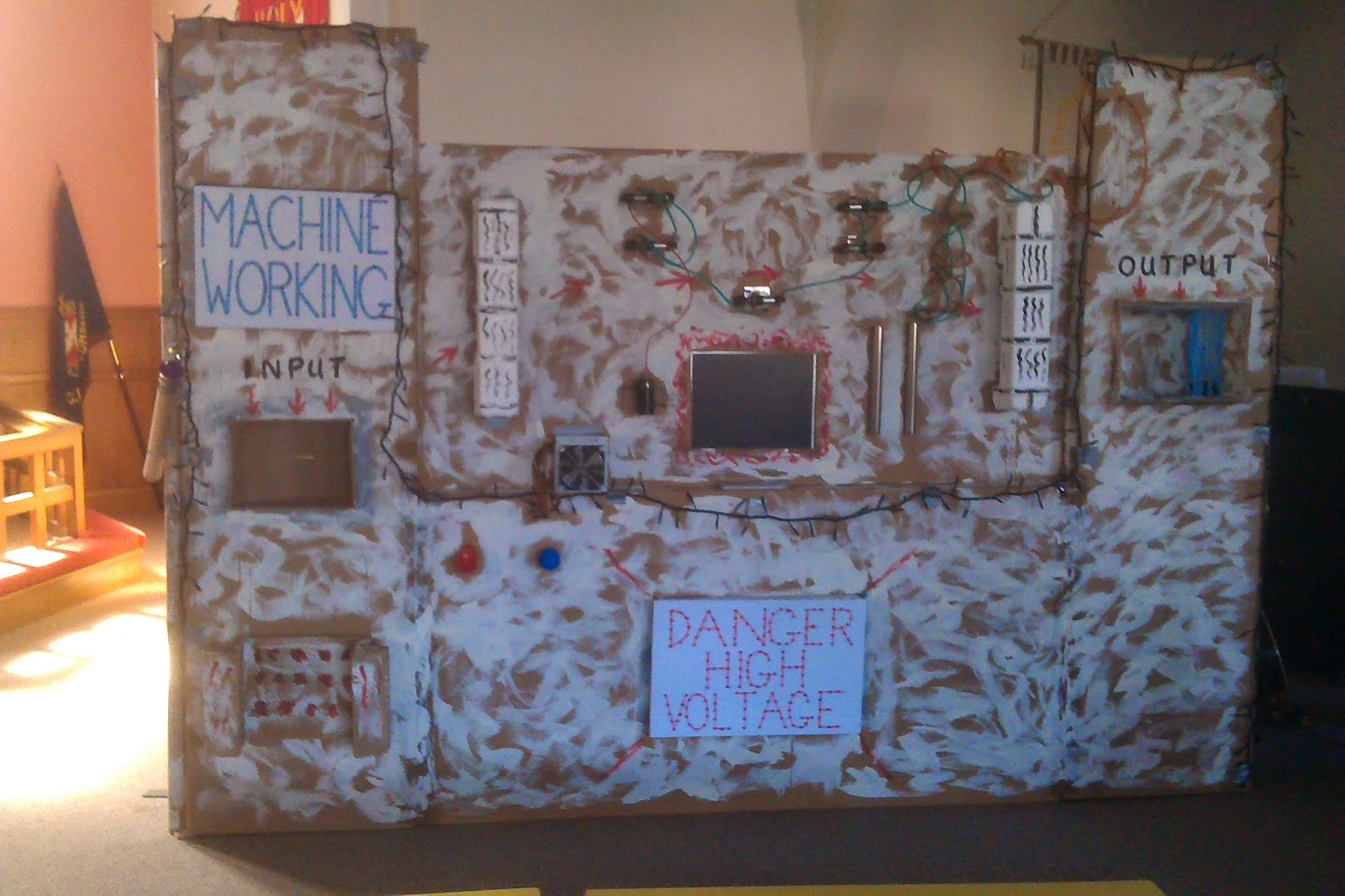
There was a slot to input the object which needed to be made bigger. The object then disappeared into the machine, and eventually came out of another slot greatly increased in size!
As I thought about this wonderful creation, an interesting question occurred to me: If I had access to a machine which could make things bigger, and I had the choice of making one thing bigger in my own life, what would it be? The possibilities seem endless! With the Commonwealth games currently in full swing, I suppose that the athletes taking part might opt to have their muscles, endurance or agility etc. made bigger.
Some people, when faced with this question, might elect to choose something which would be of direct personal benefit: a bigger car, house, bank balance, salary etc. There is something about money and possessions which seems strangely attractive to many people, even though these things rarely provide the kind of lasting satisfaction or happiness which they might initially seem to promise.
Of course, an alternative response to the opportunity to use a Mega Machine could be rather more altruistic. We could make bigger something which would benefit others rather than ourselves. For example, one's motivation in making one's bank account bigger might be in order to be able to give more money away to charity, to improve the lives of others. Or one could perhaps choose to increase the capacity of our love, concern, or compassion for others, or our work skills. For a Christian, the decision might be to deeper one's relationship with Jesus or one's understanding of the Bible, or to increase one's faith.
I haven't yet finally decided on what I would want to increase, but I do find it a fascinating and challenging question.
Monday, 28 July 2014
Monday, 21 July 2014
Swimming between the flags
About three weeks ago I was in Scarborough, and took
advantage of a sunny morning to take one of my favourite walks along Marine
Drive. Marine Drive was constructed at
the end of the nineteenth century, and is the connecting road between
Scarborough’s north and south bays. On
one side are the cliffs which lead up to the ancient castle; on the other is
the North Sea.
Having reached the North Bay area, I looked out over the
sands and noticed two flags which had been placed there by lifeguards. Along with the two flags there was a notice
which instructed users of the beach that they should only swim in that part of
the sea situated between the two flags.
Scarborough has lovely beaches, which slope gradually down towards the
sea, and I have always regarded them as ideal for bathing (if you can cope with
the less than Mediterranean temperatures!)
My first reaction to the notice was to think that the lifeguards were
being unnecessarily restrictive in seeking to limit swimming to such a
relatively small part of the beach.
As I thought more about it, however, I acknowledged that
their purpose in placing the restriction was in ensuring the safety and
security of the users of the beach, and in particular the swimmers. Of course, swimmers still had a choice. They could choose to follow the instructions
and know that they were in a safe area, with someone watching out for their
welfare and security. On the other hand,
they could choose to disregard the instructions and accept the risk which comes
with the choice (a number of people have drowned in the sea at Scarborough and
other seaside resorts over the years).
As I pondered this situation, into my mind dropped the clear
parallel with God’s instructions for living as we find them in the Bible. God tells us the best way to live, yet he
also gives human beings the gift of free will.
We can choose to either embrace God’s ways or reject them. As we look around our society and the world
today, we can see clearly some of the consequences of choosing to disregard God’s
way. Just listen to the news headlines!
Some have the opinion that the Bible is out of date and no
longer relevant, and that we human beings can live our lives perfectly well without reference to God. All one needs to do to
recognise the fallacy of that belief is to imagine how life would
be improved if, for example, human beings lived by the 10 Commandments; that in itself
will tell us how much better it is to live in obedience to God. It really is much safer to swim between the
flags!
Monday, 14 July 2014
The Power of Presence
Sue and I have recently returned from a fortnight's holiday. The first part, at least, didn't quite work out as planned. After my Sunday evening service we headed up to Scarborough, intending to spend several days there. On the Monday we heard news that our grandson, Ben, has been taken into hospital. There is something about being relatively far away from events which makes such a situation feel even worse than it might otherwise have done.
As the day progressed Ben was very much in our thoughts and prayers, and we contacted friends and family to ask them to pray, too. The news we received was not good, as the doctors seemed to think that the indications were that Ben had contracted meningitis, which of course is a very serious infection, and one which can prove fatal.
We know very well that prayer can be effective "from a distance". Numerous people over the years have told me that they have experienced the blessings and strength which the prayers of others have brought, even though their praying friends were not physically present with them. Sue and I knew that God could answer our prayers for Ben, even though we were a 3-hour car journey away from him as he lay in his hospital bed. Yet despite this, I really felt that we needed to be with Ben and his family, and to pray over him personally. So, late on the Monday night, we headed back to Leicester, and discovered that one of the benefits of driving at that time is the relatively quiet roads!
Early on the Tuesday morning we went into the Leicester Royal Infirmary and saw Ben and his mum, Megan. Ben was clearly not himself, and was quite poorly, but it was lovely to be able to hold him in our arms and pray for God's blessing and healing power into our beautiful little grandson.
Ben slowly began to pick up, and we thank God that through a combination of prayer and antibiotics he is now well and back home with his family. On reflection, it is quite possible that even if we had stayed in Scarborough and prayed from there, the outcome might have been just the same. Yet at the same time I think that it was right on that occasion that we returned home.
There will no doubt be some situations where to be present with the person in need is just not possible. We and Ben's mum and dad, Megan and Chris, are really grateful for the love and prayers which were received during Ben's illness from many people who were not in the hospital with Ben. But there is undoubtedly something very powerful about actually being present at a time of need. Often it's not the words we might say, but simply the act of showing our love and concern by being there - the Power of Presence.
One of the names given to Jesus is "Emmanuel" which means "God with us." God is not a remote, far-away figure, but One whom through Jesus stepped into our world and became Present amongst us. That's how much he loves us and it makes all the difference in the world.
As the day progressed Ben was very much in our thoughts and prayers, and we contacted friends and family to ask them to pray, too. The news we received was not good, as the doctors seemed to think that the indications were that Ben had contracted meningitis, which of course is a very serious infection, and one which can prove fatal.
We know very well that prayer can be effective "from a distance". Numerous people over the years have told me that they have experienced the blessings and strength which the prayers of others have brought, even though their praying friends were not physically present with them. Sue and I knew that God could answer our prayers for Ben, even though we were a 3-hour car journey away from him as he lay in his hospital bed. Yet despite this, I really felt that we needed to be with Ben and his family, and to pray over him personally. So, late on the Monday night, we headed back to Leicester, and discovered that one of the benefits of driving at that time is the relatively quiet roads!
Early on the Tuesday morning we went into the Leicester Royal Infirmary and saw Ben and his mum, Megan. Ben was clearly not himself, and was quite poorly, but it was lovely to be able to hold him in our arms and pray for God's blessing and healing power into our beautiful little grandson.
Ben slowly began to pick up, and we thank God that through a combination of prayer and antibiotics he is now well and back home with his family. On reflection, it is quite possible that even if we had stayed in Scarborough and prayed from there, the outcome might have been just the same. Yet at the same time I think that it was right on that occasion that we returned home.
There will no doubt be some situations where to be present with the person in need is just not possible. We and Ben's mum and dad, Megan and Chris, are really grateful for the love and prayers which were received during Ben's illness from many people who were not in the hospital with Ben. But there is undoubtedly something very powerful about actually being present at a time of need. Often it's not the words we might say, but simply the act of showing our love and concern by being there - the Power of Presence.
One of the names given to Jesus is "Emmanuel" which means "God with us." God is not a remote, far-away figure, but One whom through Jesus stepped into our world and became Present amongst us. That's how much he loves us and it makes all the difference in the world.
Sunday, 29 June 2014
Creation speaks
One of my Dad’s
first jobs after leaving school was as a gardener. Although he subsequently changed career, he
never lost his love for gardening, and he was extremely gifted in that
area. In our early married life,
whenever Sue and I moved house, Dad would come and sort out the garden for
us. It never ceased to amaze me how
quickly the transformation was accomplished.
Sadly, I didn’t
inherit his gardening talent, although I do enjoy spending time in the
garden. I can also appreciate the
wonders of God’s creation. A Flower
Festival has been taking place this weekend at Markfield, one of my churches,
and I have thoroughly enjoyed taking time to examine the wonderfully creative
floral presentations (not to mention sampling some of the equally wonderful
cake creations!)
This morning we
had our Flower Festival Service. The
congregation was surrounded by the floral displays, and our senses were given a
rare treat, both visually and through the lovely aroma emanating from some of
the flowers.
It wasn’t
difficult to find Bible verses suitable for the occasion. For example, we read from Psalm 103, which
includes these words: ‘As for us, our life is like grass.
We grow and flourish like a wild flower; then the wind blows on it, and
it is gone - no one sees it again.’ (v15-16). These words remind us of the reality of human
mortality; our earthly lives are but a speck in the annals of time. The psalmist continues: ‘But for those who honour the Lord, his love lasts forever, and his goodness endures for all generations…’
(v17). God is not restricted to the confines of time
and space, nor is his eternal love for us.
Life as we know it is a cycle of new birth, flourishing, fading and
dying; but through it all, God’s faithfulness remains: ‘The grass withers, the flower fades, but the word of our God will
stand forever.’ (Isaiah 40:8)
Our earthly lives are finite; we know that they will come
to an end. But if our faith is in Jesus
Christ, then our eternal destiny is secure.
For death is not the end of life, it is a doorway into a new life in the
very presence of God. In the beauty of
creation, we can see the hand of the Creator.
The One who created all the beauty around us also created you and me,
and he loves us with a love which will never end. How amazing is that?
Monday, 23 June 2014
"It's me" ???
[No more blogs relating to the Football World Cup 2014; the subject is far too painful for any England supporter!]
I tend to receive quite a few phone calls in the average day. Usually when the person on the other end of the line begins to speak, they give their name. There are some occasions, however, when the person concerned launches into a conversation without first giving their identity. They might say, "Hello, how are you?" or simply "It's me". Of course when that happens, and you don't immediately recognise the voice, a dilemma arises. They obviously think that you should be able to recognise their voice, so do you risk offending them by asking them to identify themselves? Or do you continue with the conversation, hoping to pick up clues which will enable you to recognise the person to whom you are speaking?
Over the past few weeks I have been running a Prayer Course in one of my churches. The course looks at different elements of prayer, using The Lord's Prayer as a basis. The theme for last week's session was 'Listening to God', recognising that prayer is supposed to be two-way (a dialogue, not a monologue). I must confess that hearing God's voice is an area where I have sometimes struggled. Of course God rarely seems to speak through an audible voice; usually the voice of God can come to us through many different ways (e.g. through the Bible, through everyday incidents, through friends, through an impression or thought in the mind etc.)
Having said that, one big question is how do we recognise God speaking to us when we may also be hearing many other 'voices'. It seems that one key Bible verse comes in Psalm 46:10, when God says, 'Be still and know that I am God.' Sometimes we live such busy, hectic, 'noisy' lives that we fail to hear God's voice. We need to create times when we can simply be still in God's presence. I have always found first thing in the morning, before the day's busyness kicks in, to be a good time to 'be still' with God, though I acknowledge that time will not suit everyone. We all need to work out what's best for us.
Another important pointer which came through the Prayer Course was that the more we learn to focus on hearing God's voice, the more we will be able to recognise when he speaks. If a member of my family, or a close friend rings me and says, "Hi, it's me" the chances are that I will recognise their voice, because I have spent much time with them, have established a close relationship, and have come to know what their voice sounds like. The more time we spend in conversation (prayer) with God, the better we will become at recognising his voice. What could be more special than hearing the voice of God?
I tend to receive quite a few phone calls in the average day. Usually when the person on the other end of the line begins to speak, they give their name. There are some occasions, however, when the person concerned launches into a conversation without first giving their identity. They might say, "Hello, how are you?" or simply "It's me". Of course when that happens, and you don't immediately recognise the voice, a dilemma arises. They obviously think that you should be able to recognise their voice, so do you risk offending them by asking them to identify themselves? Or do you continue with the conversation, hoping to pick up clues which will enable you to recognise the person to whom you are speaking?
Over the past few weeks I have been running a Prayer Course in one of my churches. The course looks at different elements of prayer, using The Lord's Prayer as a basis. The theme for last week's session was 'Listening to God', recognising that prayer is supposed to be two-way (a dialogue, not a monologue). I must confess that hearing God's voice is an area where I have sometimes struggled. Of course God rarely seems to speak through an audible voice; usually the voice of God can come to us through many different ways (e.g. through the Bible, through everyday incidents, through friends, through an impression or thought in the mind etc.)
Having said that, one big question is how do we recognise God speaking to us when we may also be hearing many other 'voices'. It seems that one key Bible verse comes in Psalm 46:10, when God says, 'Be still and know that I am God.' Sometimes we live such busy, hectic, 'noisy' lives that we fail to hear God's voice. We need to create times when we can simply be still in God's presence. I have always found first thing in the morning, before the day's busyness kicks in, to be a good time to 'be still' with God, though I acknowledge that time will not suit everyone. We all need to work out what's best for us.
Another important pointer which came through the Prayer Course was that the more we learn to focus on hearing God's voice, the more we will be able to recognise when he speaks. If a member of my family, or a close friend rings me and says, "Hi, it's me" the chances are that I will recognise their voice, because I have spent much time with them, have established a close relationship, and have come to know what their voice sounds like. The more time we spend in conversation (prayer) with God, the better we will become at recognising his voice. What could be more special than hearing the voice of God?
Monday, 16 June 2014
When appearances deceive
The 2014 football World Cup is well underway. (Those few words will entice a yawn from some and perhaps an increased level of engagement from others - if my wife, Sue, has started reading this blog she probably stopped after that first sentence!) Perhaps not altogether surprisingly, England lost their first match to Italy, though if the truth be known they did put on a reasonably good performance. Hope is still alive for England's further progression in the competition, with two more group games to play; we shall see!
One of the talking points in the lead-up to the England v Italy match was the fact that the game would be played in the north of Brazil, at Manaus. There was some concern about whether the relatively high temperatures and humidity of northern Brazil might have an adverse effect on the team's performance. In reality the players coped reasonably well, although a few did suffer from cramp late in the match. As the game drew nearer, the focus of concern switched to the state of the playing surface. Apparently the pitch has been fed with too much fertiliser, causing a swathe of dark patches where the grass had been burnt. It certainly didn't appear to be a pitch which was likely to be conducive to good football.
This led to perhaps the most comedic moment of the World Cup so far when some workmen were pictured apparently spraying the pitch with green paint to improve its appearance!
By the time kick-off arrived, the pitch certainly had a much improved appearance, though I'm not convinced that making it look better helped the players play any better. I'm sure they would have been very upset if they got paint on their expensive designer boots!
There seems to be something in our human nature which encourages us to try and cover things up. If someone asks us how we are, we might reply, "fine, thanks", when underneath we're feeling anything but fine. If we've done something which we knew was wrong or would cause hurt in some way to others, we might try and cover it up in the hope that no-one finds out about it. There are lots of ways in which we can be tempted to cover things up, and this doesn't just apply to individuals. The Freedom of Information Act created a public "right of access" to information held by public authorities, information which in some cases might otherwise have been kept under cover.
In this regard, one of the most startling, and perhaps unnerving, things Jesus said to his disciples was, 'There is nothing concealed that will not be disclosed, or hidden that will not be made known. What you have said in the dark will be heard in the daylight, and what you have whispered in the ear in the inner rooms will be proclaimed from the roofs.' (Luke 12:2&3). It's not a clear cut black-and white issue, but maybe there are times when we need to avoid the "cover it up" approach, and be more honest and open. Certainly Jesus' words give plenty of food for thought!
One of the talking points in the lead-up to the England v Italy match was the fact that the game would be played in the north of Brazil, at Manaus. There was some concern about whether the relatively high temperatures and humidity of northern Brazil might have an adverse effect on the team's performance. In reality the players coped reasonably well, although a few did suffer from cramp late in the match. As the game drew nearer, the focus of concern switched to the state of the playing surface. Apparently the pitch has been fed with too much fertiliser, causing a swathe of dark patches where the grass had been burnt. It certainly didn't appear to be a pitch which was likely to be conducive to good football.
This led to perhaps the most comedic moment of the World Cup so far when some workmen were pictured apparently spraying the pitch with green paint to improve its appearance!
By the time kick-off arrived, the pitch certainly had a much improved appearance, though I'm not convinced that making it look better helped the players play any better. I'm sure they would have been very upset if they got paint on their expensive designer boots!
There seems to be something in our human nature which encourages us to try and cover things up. If someone asks us how we are, we might reply, "fine, thanks", when underneath we're feeling anything but fine. If we've done something which we knew was wrong or would cause hurt in some way to others, we might try and cover it up in the hope that no-one finds out about it. There are lots of ways in which we can be tempted to cover things up, and this doesn't just apply to individuals. The Freedom of Information Act created a public "right of access" to information held by public authorities, information which in some cases might otherwise have been kept under cover.
In this regard, one of the most startling, and perhaps unnerving, things Jesus said to his disciples was, 'There is nothing concealed that will not be disclosed, or hidden that will not be made known. What you have said in the dark will be heard in the daylight, and what you have whispered in the ear in the inner rooms will be proclaimed from the roofs.' (Luke 12:2&3). It's not a clear cut black-and white issue, but maybe there are times when we need to avoid the "cover it up" approach, and be more honest and open. Certainly Jesus' words give plenty of food for thought!
Monday, 9 June 2014
Missing out on the essentials?
Junk mail is one of the facts of modern life. Most of ours finds its way very quickly into the recycling box (so it can return some day as a different piece of junk mail, perhaps!) Sometimes we may give the item a cursory glance, especially if Sue gets to it first! One particular item arrived last week, and on the way to the bin I noticed with some interest the strap-line on the cover, "Essential items at everyday low prices"
Well, I thought, if they really are essential items I'd better have a look! I soon discovered that items classed as essential are such things as laptops, LED Smart TVs, fridge freezers, a number of other electrical goods, various items of furniture and other sundry items. So does this mean that anyone without these items if somehow incomplete?
Of course I recognise that most, if not all, of the items named would be regarded by many on the UK as fairly important, if not essential. Yet I have a nagging feeling that this leaflet is a symptom or example of the materialistic culture in which we now live. And so many have discovered to their cost that however many "things" they possess, ultimately these possessions don't bring lasting satisfaction.
Many years ago I heard a story about a man who decided to visit a missionary who was living and working in a very remote part of the world, in a situation which lacked many of the creature comforts which people in the West often take for granted. When the visitor arrived at his destination, he was show around the very basic accommodation by the missionary, who said, "If there's anything you need, let me know, and I'll show you how to manage without it!"
Perhaps surprisingly (or perhaps not), Jesus seems to have spoken quite a bit about wealth and possessions. For example, he warned, ‘Watch out! Be on your guard against all kinds of greed; life does not consist in an abundance of possessions.’
Many people think that that Bible tells us that money is the root of all evil. In fact that isn't what the Bible teaches. What St Paul actually wrote to Timothy is, 'the love of money is a root of all kinds of evil.' If we allow money or possessions to become a controlling passion, we are in great danger of missing out on true life as God intended it for us. As Jesus himself challengingly asks, 'What good is it for someone to gain the whole world, yet forfeit their soul?
The leaflet did find its way to the bin. On this occasion I think that we can manage without one or two "essentials!"
Well, I thought, if they really are essential items I'd better have a look! I soon discovered that items classed as essential are such things as laptops, LED Smart TVs, fridge freezers, a number of other electrical goods, various items of furniture and other sundry items. So does this mean that anyone without these items if somehow incomplete?
Of course I recognise that most, if not all, of the items named would be regarded by many on the UK as fairly important, if not essential. Yet I have a nagging feeling that this leaflet is a symptom or example of the materialistic culture in which we now live. And so many have discovered to their cost that however many "things" they possess, ultimately these possessions don't bring lasting satisfaction.
Many years ago I heard a story about a man who decided to visit a missionary who was living and working in a very remote part of the world, in a situation which lacked many of the creature comforts which people in the West often take for granted. When the visitor arrived at his destination, he was show around the very basic accommodation by the missionary, who said, "If there's anything you need, let me know, and I'll show you how to manage without it!"
Perhaps surprisingly (or perhaps not), Jesus seems to have spoken quite a bit about wealth and possessions. For example, he warned, ‘Watch out! Be on your guard against all kinds of greed; life does not consist in an abundance of possessions.’
Many people think that that Bible tells us that money is the root of all evil. In fact that isn't what the Bible teaches. What St Paul actually wrote to Timothy is, 'the love of money is a root of all kinds of evil.' If we allow money or possessions to become a controlling passion, we are in great danger of missing out on true life as God intended it for us. As Jesus himself challengingly asks, 'What good is it for someone to gain the whole world, yet forfeit their soul?
The leaflet did find its way to the bin. On this occasion I think that we can manage without one or two "essentials!"
Subscribe to:
Posts (Atom)


