Sue and I attended a conference last year at which one of the speakers was a guy called Patrick Regan. He came across as a very engaging character, and what he had to say was extremely thought-provoking. As a result of hearing him speak, we bought his book, 'When Faith Gets Shaken', which reflects on how we can focus on God and keep going through the tough times of life - when our faith gets shaken. The book is not an airy-fairy theoretical book, but one which was written out of real-life issues which the author faced in his own life; it grapples with some very difficult matters relating to suffering and how we can respond as people of faith.
Subsequent to reading the book, I discovered that there was a DVD looking at the same issues. I bought the DVD and we have recently started using the 6-session series in one of my churches. The subject for our first session last week was, "God, where are You?" In other words, where is God in our times of struggle and pain? We had an interesting discussion after watching the DVD.
I have recently begun reading a book by former atheist Lee Strobel, 'The Case For Faith', in which he examines 8 common objections to Christian faith, the first of which is the issue of suffering, addressing the question as to how can a loving God exist when there is so much evil and suffering in the world? There have probably been hundreds of books written on this subject, and it is true to say that we are never going to fully understand the subject. Nevertheless, there are some things which we can say. I am finding Strobel's book very helpful in thinking through some key issues.
As I have been pondering on the discussion which we had at last week's 'When Faith Gets Shaken' session and on what I have since read, into my thoughts came a memory from when our daughter Caroline was still in her very early years. She had to undergo an operation at the local hospital. Although it was a relatively minor operation, I remember feeling distraught as she was wheeled away on a trolley towards the operating theatre. I felt tears come to my eyes, and I would have given anything to have taken her place if that had been possible. Thankfully she came safely through the procedure.
A couple of thoughts come out of that experience. Firstly, because Caroline was so young and probably didn't understand fully what was happening to her, it would have been quite understandable for her in her young mind to think that Sue and I didn't care for her as we handed her over to strangers to take her and do something to her which caused her pain. That's because she couldn't grasp the 'big picture', that it was necessary for her to have the operation for her future health. I am convinced that much of our problem with suffering is that we can't grasp the big picture as God sees it. As God says through the prophet Isaiah,
'For my thoughts are not your thoughts,
neither are your ways my ways,”
declares the Lord.
As the heavens are higher than the earth,
so are my ways higher than your ways
and my thoughts than your thoughts.' Isaiah 55.7-9.
The second though which comes as a result of our experience many years ago with Caroline has to do with what I have already said, that I would have given anything to have changed places with her and taken the pain myself. There is a sense, of course, in which that is what God has done for us. He stepped into our world through his Son Jesus Christ. Jesus became one of us, and suffered the torture and agony of the cross, taking on himself the weight of the sin of the world. Imagine the depths of sorrow in the heart of God the Father as he witness the crucifixion of his Son. God is not a remote and far-away God, but a God who is fully acquainted with suffering. What's more, he promises to be with with us in whatever we experience; 'I will never never you or forsake you' (Hebrews 13.5).
The book of the Bible which most directly deals with the issue of suffering, of course, is Job. Job was a person who suffered a great deal, and constantly questions God about what has happened to him. Ultimately, Job was only satisfied when he came face to face with God: 'My ears had heard of you but now my eyes have seen you' (Job 42.5). The questions about suffering will remain, but as we look fully into the face of the God who created us and loves us, we will find courage to live with the questions, and strength to trust him in life's storms
Wednesday, 17 October 2018
Tuesday, 9 October 2018
Be a bucket filler
One day last week I received an image on my phone of my granddaughter Beth holding a certificate she had been awarded by her school. Judging by the big smile on her face, she was very happy to have received it. I was somewhat puzzled by the nature of the award, however, as the certificate was headed, "Bucket filler of the week." A number of images went through my mind as I pondered on the meaning of this phrase.
The wording on the front of the certificate read, "This certificate is awarded to Beth for being an outstanding bucket filler this week", and underneath was written the word "kindness".
The back of the certificate gave some clarifying detail:
Remember to fill a bucket!
We are bucket fillers when we:
show love to someone,
say or do something kind,
give someone a smile,
make others feel special,
or care for someone.
Remember ... when you fill someone's bucket, you fill your bucket, too!
The idea is that we all carry invisible buckets around with us. If our buckets are full, we are happy and content; having an empty bucket leads to sadness. The challenge is to fill the buckets of other people through acts of kindness, love and thoughtfulness. And we find that as we fill the buckets of others, our own bucket is being filled. On the other hand, if we act in an unkind way towards someone, or speak ill of a person, not only are we emptying their bucket but also our own.
What a great way to encourage children (and adults!) to consider how they treat other people. It certainly fits in well with how we are called to live as followers of Jesus. St. Paul, for example, tells us, 'Be kind to one another, tenderhearted, forgiving one another, as God in Christ forgave you' (Ephesians 4.32). God has filled our buckets with his love, grace and forgiveness; how can we not seek to do our best to fill the buckets of others?
The wording on the front of the certificate read, "This certificate is awarded to Beth for being an outstanding bucket filler this week", and underneath was written the word "kindness".
The back of the certificate gave some clarifying detail:
Remember to fill a bucket!
We are bucket fillers when we:
show love to someone,
say or do something kind,
give someone a smile,
make others feel special,
or care for someone.
Remember ... when you fill someone's bucket, you fill your bucket, too!
The idea is that we all carry invisible buckets around with us. If our buckets are full, we are happy and content; having an empty bucket leads to sadness. The challenge is to fill the buckets of other people through acts of kindness, love and thoughtfulness. And we find that as we fill the buckets of others, our own bucket is being filled. On the other hand, if we act in an unkind way towards someone, or speak ill of a person, not only are we emptying their bucket but also our own.
What a great way to encourage children (and adults!) to consider how they treat other people. It certainly fits in well with how we are called to live as followers of Jesus. St. Paul, for example, tells us, 'Be kind to one another, tenderhearted, forgiving one another, as God in Christ forgave you' (Ephesians 4.32). God has filled our buckets with his love, grace and forgiveness; how can we not seek to do our best to fill the buckets of others?
Monday, 17 September 2018
Unanswered question
One night last week I had a dream that my brother Phil was in the UK. Although (in the dream) he was not in good health, I was pleased to be able to spend some time with him. When it came time for him to leave the UK to head back to New Zealand where he lived, my emotions round the understanding that it would probably be the last time I saw him were hard to deal with. Then I woke up, with the dream still vivid in my memory, and realised that my dream was a replay of a reality from back in early 2017, when Phil had last been in the UK. We knew then that Phil was very unwell; he died from cancer a few months later.
Even though what I had just gone through was only a dream, many of the former emotions of sadness and loss resurfaced. I have to admit that during the following day I felt very low; perhaps just as well that it was my day off. It's rather strange how differing events and experiences can trigger a whole series of emotions and feelings, sometimes totally out of the blue.
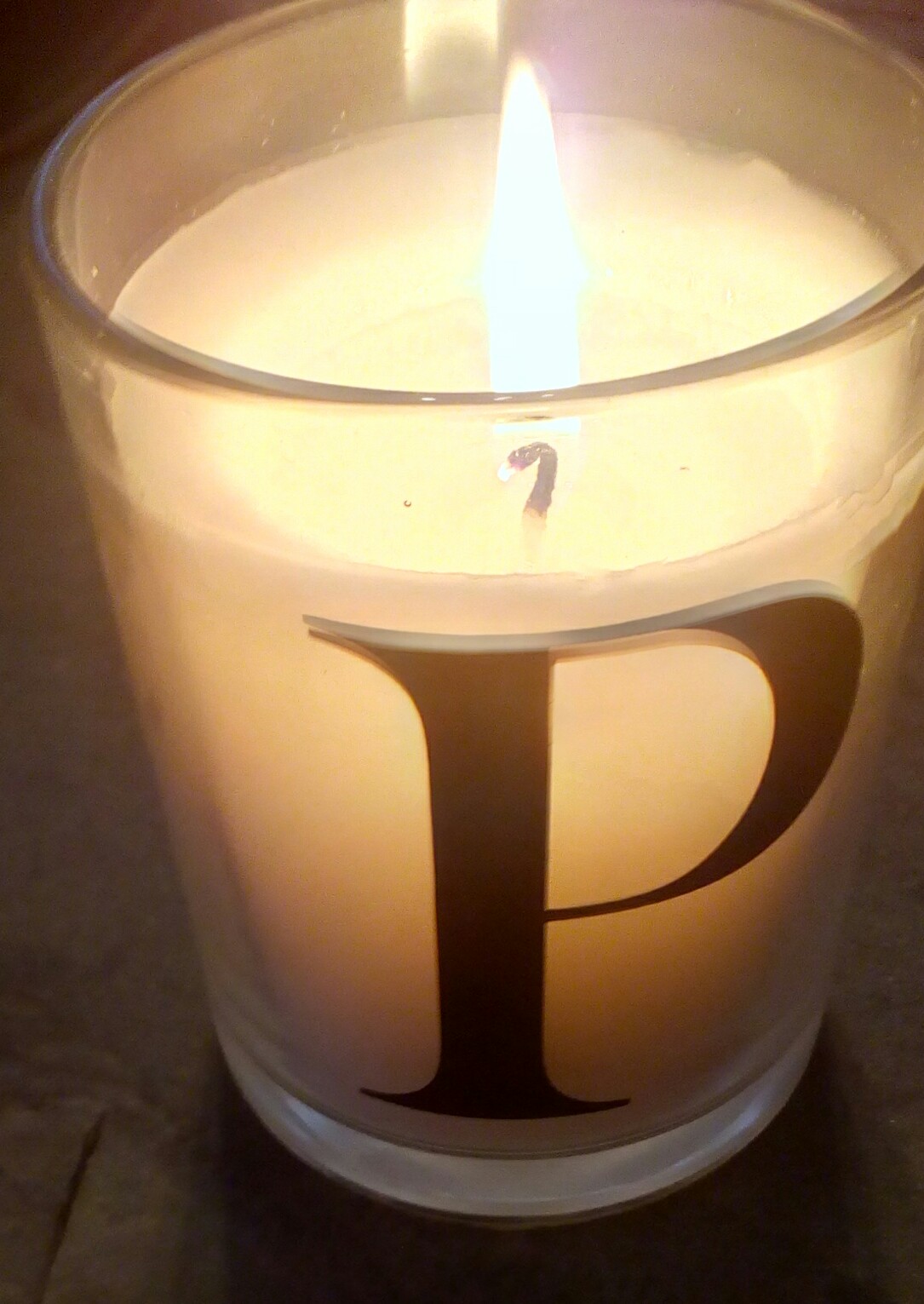
At the beginning of the month Sue and I, together with my sister Jenny and brother-in-law David, visited Newark. One of the reasons for doing so was that we wanted to spend some time giving thanks for Phil's life and praying for his family in New Zealand, on what was the first anniversary of his death. We went into the Parish Church in Newark (well worth a visit) and lit a candle as we prayed. The candle was one given me by a friend not long after Phil died. It is in a small glass jar with the letter "P" printed on one side.
As we prayed, and reflected in the silence, the candle became a focal point. As I stared at the candle I happened to notice that the wick looked as if it was in the shape of a question mark. I felt that was significant, as there were unanswered questions as we thought of Phil's death.
Phil was the youngest member of our family of 6 children. He and his wife Monika were doing a great job in New Zealand through Church Army. Phil had a great passion for reaching the nation with the love of Jesus. The testimonies which flooded in after his death gave eloquent testimony to the enormous positive influence Phil had had on so many people. He had a great vision for the future. All over the world people were praying for his healing. Though some physical healing did come, ultimately he died in his mid 50s. A life cut short? 'Why did God allow it to happen?' is a question which many will have asked. There seems no logical answer.
So we are left with a choice. Do we rail against God and blame him for making a ghastly mistake? Or do we simply leave the question unanswered and trust that God knows best? I have chosen the latter. I don't suppose we will ever get a complete answer to some of the questions on our hearts and minds, but we need to take heed of God's words through the prophet Isaiah:
For my thoughts are not your thoughts,
neither are your ways my ways,”
declares the Lord.
“As the heavens are higher than the earth,
so are my ways higher than your ways
and my thoughts than your thoughts. Isaiah 55.8&9.
Lord God, though I don't understand everything that happens, I choose to put my trust in you. Though our loss still hurts greatly, I thank you that you draw close to comfort the sorrowful. Thank you that all those who trust in your Son have the assurance of life eternal in your presence.
Even though what I had just gone through was only a dream, many of the former emotions of sadness and loss resurfaced. I have to admit that during the following day I felt very low; perhaps just as well that it was my day off. It's rather strange how differing events and experiences can trigger a whole series of emotions and feelings, sometimes totally out of the blue.
At the beginning of the month Sue and I, together with my sister Jenny and brother-in-law David, visited Newark. One of the reasons for doing so was that we wanted to spend some time giving thanks for Phil's life and praying for his family in New Zealand, on what was the first anniversary of his death. We went into the Parish Church in Newark (well worth a visit) and lit a candle as we prayed. The candle was one given me by a friend not long after Phil died. It is in a small glass jar with the letter "P" printed on one side.
As we prayed, and reflected in the silence, the candle became a focal point. As I stared at the candle I happened to notice that the wick looked as if it was in the shape of a question mark. I felt that was significant, as there were unanswered questions as we thought of Phil's death.
Phil was the youngest member of our family of 6 children. He and his wife Monika were doing a great job in New Zealand through Church Army. Phil had a great passion for reaching the nation with the love of Jesus. The testimonies which flooded in after his death gave eloquent testimony to the enormous positive influence Phil had had on so many people. He had a great vision for the future. All over the world people were praying for his healing. Though some physical healing did come, ultimately he died in his mid 50s. A life cut short? 'Why did God allow it to happen?' is a question which many will have asked. There seems no logical answer.
So we are left with a choice. Do we rail against God and blame him for making a ghastly mistake? Or do we simply leave the question unanswered and trust that God knows best? I have chosen the latter. I don't suppose we will ever get a complete answer to some of the questions on our hearts and minds, but we need to take heed of God's words through the prophet Isaiah:
For my thoughts are not your thoughts,
neither are your ways my ways,”
declares the Lord.
“As the heavens are higher than the earth,
so are my ways higher than your ways
and my thoughts than your thoughts. Isaiah 55.8&9.
Lord God, though I don't understand everything that happens, I choose to put my trust in you. Though our loss still hurts greatly, I thank you that you draw close to comfort the sorrowful. Thank you that all those who trust in your Son have the assurance of life eternal in your presence.
Monday, 3 September 2018
Eye of the beholder
I was reminiscing with some friends recently about the
time (long ago) when TV viewing was restricted to a choice between BBC and ITV. Yes, that memory does age me, but it seems
almost incredible that although there are a proliferation of TV channels and
other viewing platforms these days, the number of programmes actually worth watching seems
to have risen very little! Of course, we
are all different, with varying preferences.
One programme which do enjoy watching is BBC’s Fake or Fortune, in which Fiona Bruce
and Philip Mould investigate remarkable stories beneath the surface of
paintings, sometimes uncovering previously hidden masterpieces. In one
recent programme the team investigated whether a small watercolour sketch could
be by the British 20th-century sculptor Henry Moore. In case you haven’t watched the programme, I
won’t reveal the outcome.
Works by Henry Moore appear all over the world. One of the places which has a number of his
works is Yorkshire Sculpture Park, in West Bretton, Yorkshire. I have a loose family connection with the place, as my dad
worked there as a gardener long before the Yorkshire Sculpture Park was
opened. It is a beautiful setting, and part of me
regrets that my family moved from the area before I was born!
I must admit that I am not a big fan of Moore’s works
generally; they tend to be a bit abstract for me (perhaps I am a bit of a
Philistine in that respect?) However,
Moore has a great many admirers, and his works can sell for a great deal of
money. One of his sculptures sold for
£1.8m.
My initial reaction when I heard that news was to wonder
why on earth someone would be willing to pay such a price for a rather weird (in
my eyes) work of art? Even if I had that
kind of money, there is no way I would spend it on a Henry Moore work. But someone obviously thought the sculpture to
be worth it.
Yes, I do find it hard to understand why someone would
pay such an amount for the sculpture.
But something far more amazing and far more wonderful is a well-known
verse in the Bible, John’s gospel chapter 3 verse 16, which says, ‘God loved the world so
much that he gave his only Son, so that everyone who believes in him may not
die but have eternal life.’ God values every human being so much that he was willing to give his
own Son for us. How can God value us,
with all our human frailties and sinfulness, that much? There is only one answer: love. Truly incredible.
Thursday, 9 August 2018
Michael or Jo?
Michael Johnson was one of my sporting heroes. When he was at the height of his athletic ability he was practically unbeatable at either 200 or 400 metres, becoming world record holder at both distances and multi Olympic champion. Though he retired from athletics some years ago, the memories remain. He regularly appears on the BBC, giving informed comments on athletic events.
When, a few months ago, I recognised that I needed to lose some weight and also regain a level of fitness, I decided to have a go at using the Couch to 5K app, a programme designed to build up fitness over a nine week period so that even a novice runner should be able to run 5K by the end of the programme. The programme offers a choice of four celebrity coaches who offer support and encouragement via a podcast to those who take part in the programme. When I saw that one of the coaches was Michael Johnson, I naturally chose him as my coach. All was going well until, during the fourth week of the programme, I developed a very painful calf injury which meant that I had to stop using the Couch to 5K programme.
The injury took quite some time to heal, but I recently decided to give the programme another go. This time, however, I decided to go with another of the celebrity coaches, radio DJ and TV presenter Jo Whiley (I have since reached week five, so far without injury!) Though quite a bit of what Michael and Jo say as you walk or jog is similar, there is a marked difference. Michael Johnson was an athletic phenomenon, and although I did a bit of athletics in my day (even running at Crystal Palace Athletics Stadium!) I was a million miles from Michael Johnson's standard. Jo Whiley, on the other hand, freely admits that she used to hate running, and that she never saw herself as a runner. However, through perseverance and commitment she has come to quite enjoy running.
Though I enjoyed being coached by a sporting hero, I find that there is a great benefit in being coached by someone like Jo Whiley, who fully understands and empathises with those who are finding the going rather difficult. When she says "I know what you're going through", you know it's true. When the going gets tough, whether with exercise or any walk of life, to have someone alongside you who has had similar experiences can be a real encouragement.
One of the benefits of jogging (apart from the health aspect) is that it can give you time to think. I have been thinking about the difference between being coached by a former world class athlete and being coached by someone who didn't really like running. The latter can more readily empathise with the ordinary man or woman who struggles with exercise. My mind then went on to think about how we know that God can empathise and get alongside us because in his Son, Jesus Christ, he actually stepped into our world and became one of us. He lived an earthly life and, as the writer of the New Testament letter to the Hebrews states, he 'understands our weaknesses since he had the same temptations we do'.
How great to know that God is not a far-away, remote and uncomprehending figure, but one who has himself experienced our humanity, and promises that as we open our lives to him he will be with us always, and will encourage and strengthen us when the going is hard.
When, a few months ago, I recognised that I needed to lose some weight and also regain a level of fitness, I decided to have a go at using the Couch to 5K app, a programme designed to build up fitness over a nine week period so that even a novice runner should be able to run 5K by the end of the programme. The programme offers a choice of four celebrity coaches who offer support and encouragement via a podcast to those who take part in the programme. When I saw that one of the coaches was Michael Johnson, I naturally chose him as my coach. All was going well until, during the fourth week of the programme, I developed a very painful calf injury which meant that I had to stop using the Couch to 5K programme.
The injury took quite some time to heal, but I recently decided to give the programme another go. This time, however, I decided to go with another of the celebrity coaches, radio DJ and TV presenter Jo Whiley (I have since reached week five, so far without injury!) Though quite a bit of what Michael and Jo say as you walk or jog is similar, there is a marked difference. Michael Johnson was an athletic phenomenon, and although I did a bit of athletics in my day (even running at Crystal Palace Athletics Stadium!) I was a million miles from Michael Johnson's standard. Jo Whiley, on the other hand, freely admits that she used to hate running, and that she never saw herself as a runner. However, through perseverance and commitment she has come to quite enjoy running.
Though I enjoyed being coached by a sporting hero, I find that there is a great benefit in being coached by someone like Jo Whiley, who fully understands and empathises with those who are finding the going rather difficult. When she says "I know what you're going through", you know it's true. When the going gets tough, whether with exercise or any walk of life, to have someone alongside you who has had similar experiences can be a real encouragement.
One of the benefits of jogging (apart from the health aspect) is that it can give you time to think. I have been thinking about the difference between being coached by a former world class athlete and being coached by someone who didn't really like running. The latter can more readily empathise with the ordinary man or woman who struggles with exercise. My mind then went on to think about how we know that God can empathise and get alongside us because in his Son, Jesus Christ, he actually stepped into our world and became one of us. He lived an earthly life and, as the writer of the New Testament letter to the Hebrews states, he 'understands our weaknesses since he had the same temptations we do'.
How great to know that God is not a far-away, remote and uncomprehending figure, but one who has himself experienced our humanity, and promises that as we open our lives to him he will be with us always, and will encourage and strengthen us when the going is hard.
Thursday, 26 July 2018
Millicent and Jesus
Earlier
this year a statue of Dame Millicent Fawcett was unveiled in Parliament Square,
London. It was the first statue of a
woman to grace the square. Millicent was
a strong supporter of the Women's Suffrage movement, becoming leader of the
National Union of Women's Suffrage Societies, a group which believed in using
non-violent tactics to persuade the government that women deserved the right to
vote in elections. This year (2018) is
the 100th anniversary of the historic moment when women were finally given the
right to vote.
Following
the giving of Royal assent to the Bill to enfranchise women and the subsequent
declaration later that year of the end of the First World War, Millicent decided
to retire from active political work. On
New Year’s Day, 1920, she received a cheque from a group of Suffrage friends as
a token of their gratitude for her work, with the condition that she was not to
give it away. She decided to take the
opportunity to do something which she had long desired, namely travel to the
Holy Land. In February 1921 she set off
on her journey, accompanied by her sister Agnes.
I am
currently reading Millicent’s book, ‘Easter in Palestine, 1921-1922’, in which she
recounts her travel experiences. It is a
fascinating volume. As may be expected,
she describes many of the places they visited, but she also comments on the
political situation, and her passion for women’s rights shines through in several
places. One of the chapter headings, for
example, is ‘A Suffrage Meeting in Jerusalem.’
A passage
in the book which particularly took my attention was when the sisters visited Nablus,
the site of Jacob’s Well, thought to be the place where Jesus had a remarkable conversation
with a Samaritan woman (recorded in John chapter 4). Millicent Fawcett comments:
‘The He
should have revealed to her the innermost heart of His own doctrine of the
relation of God to man and the nature of true worship is one of the most
marvellous things in His whole marvellous history. This great teaching was offered to one of the
despised sex belonging to a despised people; and that it was offered to a woman
at all has ever been like a guiding light on a dark and often tortuous journey
to those who have been workers for the development of women’s freedom and citizenship. The whole story is so wonderfully told we
cannot go back to it too often.’
It is
right that we acknowledge the debt which is owed to people like Millicent Fawcett
for the tremendous dedication and commitment which they gave in the struggle
for women’s suffrage. I find myself
tremendously encouraged by the fact (which is often overlooked) that Millicent
found in the gospel story, and particularly the ministry of Jesus, inspiration
for her efforts. A reminder that in God’s
eyes we are all equally loved and valued
As St Paul writes, ‘There is no difference between Jews
and Gentiles, between slaves and free people, between men and women; you are
all one in union with Christ Jesus’ (Galatians 3.28). If only our world today could live in the reality of those words!
Subscribe to:
Posts (Atom)